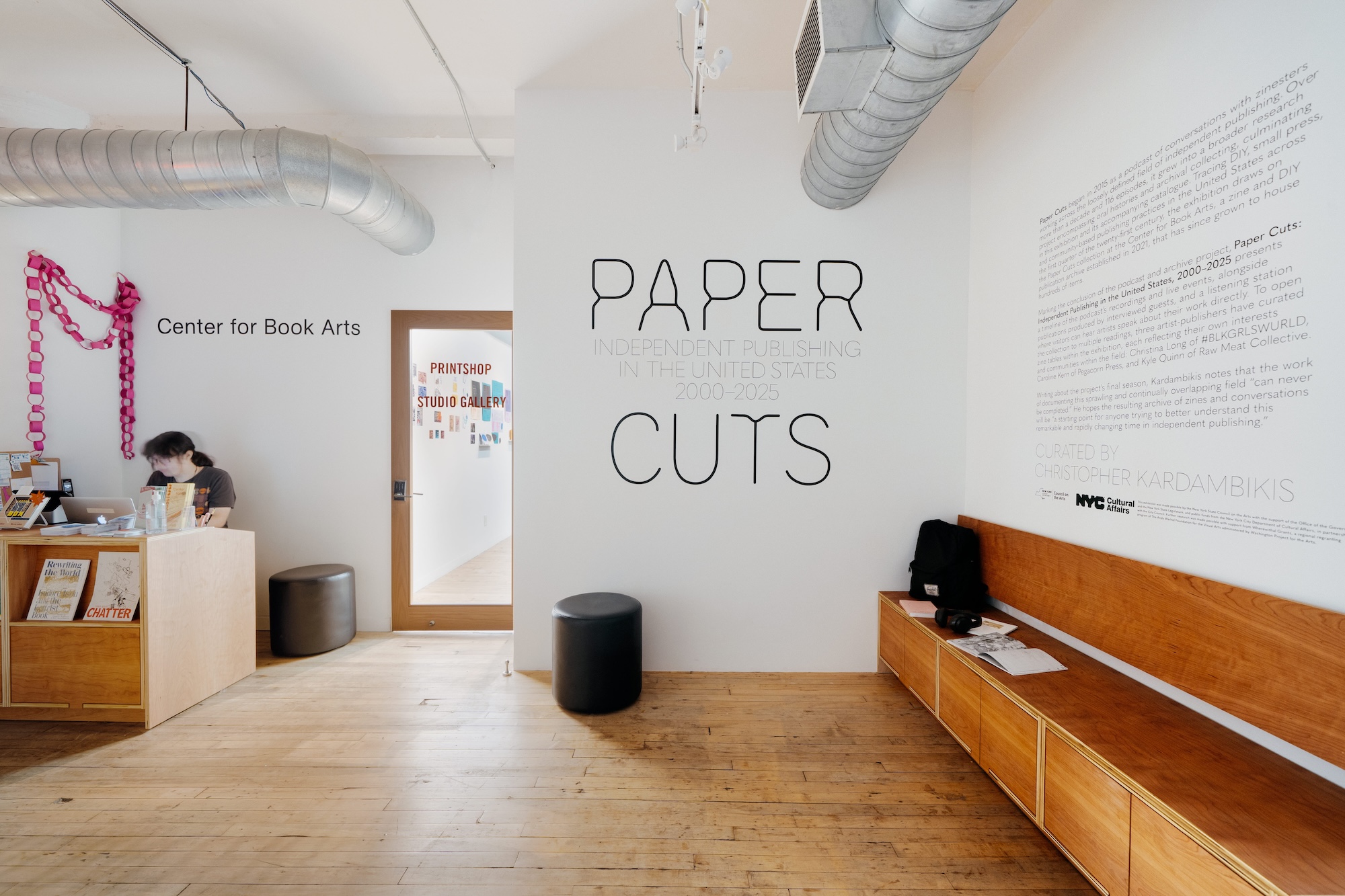
More than 600 zines and small-press publications: that is the raw material behind Paper Cuts, an exhibition at New York’s Center for Book Arts running through December 12. Collected over a decade by artist and publisher Christopher Kardambikis, these are not simply miniature magazines awaiting admission to a museum. They are evidence of how people build their own channels when existing ones do not make room for them.
The project surveys roughly 25 years of independent publishing in the United States. Kardambikis assembled the collection through travel, studio visits and conversations with artists and publishers. That method matters. A zine’s significance is rarely contained in its paper alone: there is also the person who made it, the table where it was sold, the friend who received a copy and the community that kept it moving.
According to the exhibition description, three guest curators, themselves publishers, have organized reading tables around queer publishing, Black-led editorial platforms and do-it-yourself print networks. The tables are a smart corrective to the idea of the archive as a neutral pile of objects. Who groups the material, and what relationships they recognize, changes the story it tells.
The show’s subject is also bigger than nostalgia for photocopiers and staples. Independent print has always been a practical answer to a question: who gets to speak, and who decides whether that speech circulates? Small editions can make a local scene visible to itself. They can record an argument while it is still unfolding, or preserve the names and images that more polished histories omit. Their limited circulation is not necessarily a failure of ambition. Sometimes it is the point.
Across Brooklyn, Asia Art Archive in America’s Zine* Together, on view through March 31, 2027, approaches a related question from another direction. Its focus is collaboratively produced Asian American zines dating from 2010 onward, treating publishing as a shared action rather than merely a finished object. Taken together, the exhibitions suggest that the most interesting thing about a zine may be what happens between its makers and readers.
There is a tension in bringing such work into an institution. A reading room can preserve fragile copies and introduce them to strangers; it can also make something once passed hand to hand feel untouchable. Paper Cuts addresses that tension most convincingly through its reading tables, which emphasize different networks rather than imposing a single official history.
For anyone who has picked up a stapled booklet at a show, record shop or community fair, the exhibition offers a familiar starting point. For everyone else, it offers a useful reminder: cultural history is not only written by the people with printing budgets. It is also assembled, folded, traded and kept in shoeboxes.



Leave a Reply