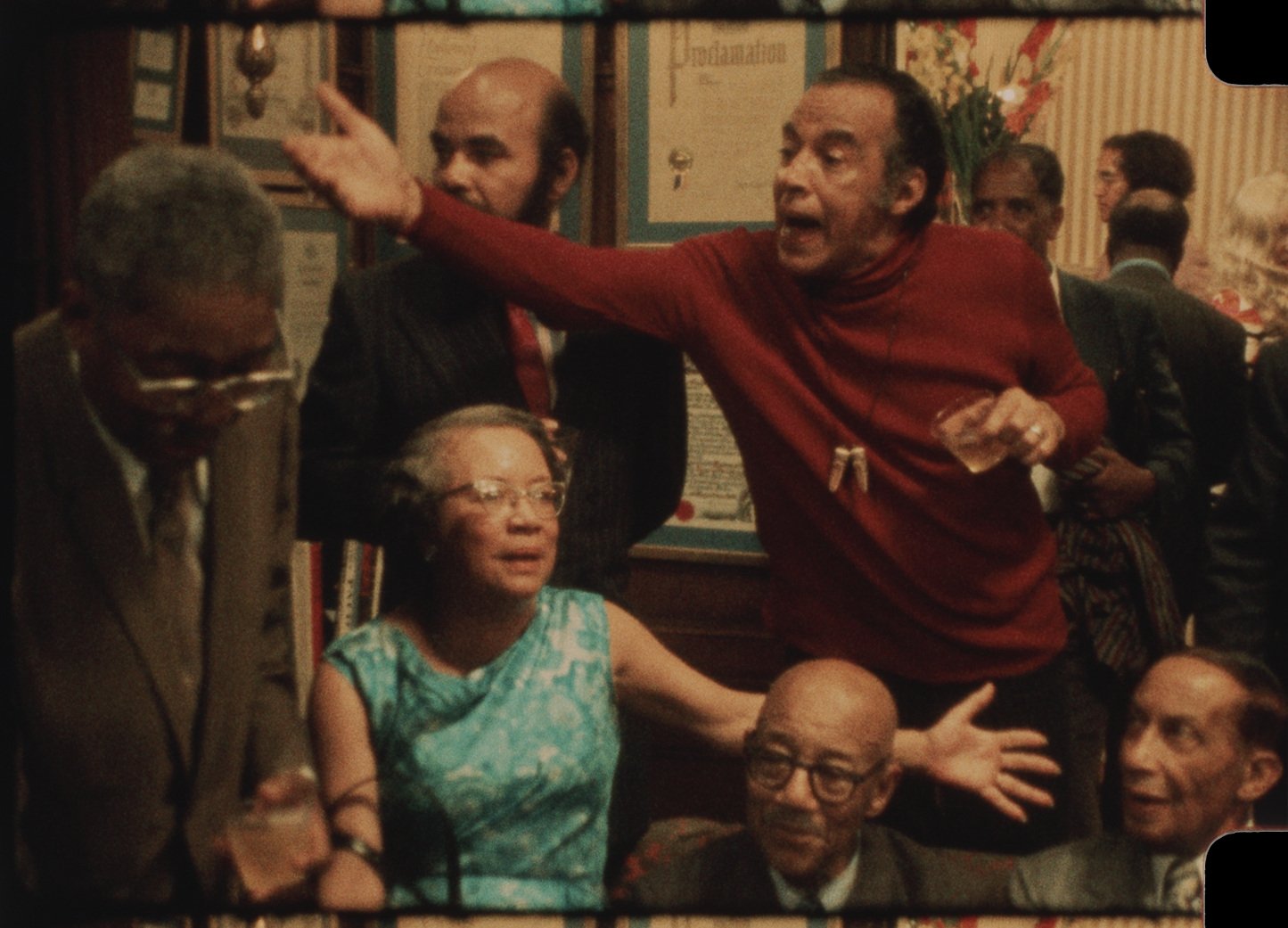
Imagine being invited to a house party where the guests include painters Romare Bearden and Aaron Douglas, poet Arna Bontemps, photographer James Van Der Zee and composer Eubie Blake. Then imagine someone had the foresight to bring cameras. That is the remarkable premise behind Once Upon a Time in Harlem, assembled from footage of a 1972 gathering at Duke Ellington’s Harlem townhouse.
Documentary filmmaker William Greaves organized and filmed the reunion in August 1972, bringing together figures associated with the Harlem Renaissance, many of whom had not seen one another for decades. It was not a staged historical pageant. As Film Forum’s program notes explain, the guests remembered, debated and occasionally revisited old disagreements. The film’s attraction lies in watching history become conversation rather than an orderly sequence of dates.
Greaves, whose experimental Symbiopsychotaxiplasm: Take One questioned what a documentary could be, never completed the project before his death in 2014. His son David, one of the original cameramen, later shaped the surviving material into a 100-minute film. It is a rare instance of an archival project where the person finishing the work was present when it began.
That continuity gives the film an unusual emotional dimension. The guests were already looking back across fifty years in 1972; today, viewers are looking back across another half-century at their recollections. Each generation hears a different history in the same room. The names may appear in museum labels and literature courses, but here the artists have voices, tempers and competing memories.
There is a larger question lurking in the party atmosphere. Cultural movements tend to acquire a neat retrospective identity: a set of major figures, landmark works and agreed dates. People who actually lived through them rarely remember them so neatly. A reunion can preserve the arguments that official histories smooth away. It can also reveal who gets to speak and whose account is challenged.
The film is currently playing at New York’s Film Forum, with screenings listed for November 21 and 22. The cinema identifies David Greaves as director and William Greaves as the filmmaker who conceived and shot the original material. Its October filmmaker Q&A listing confirms David’s involvement in the 1972 shoot and the family’s continuing stewardship of the project.
For audiences who might ordinarily skip a documentary about a celebrated artistic movement, the invitation is wonderfully simple: come to the party. The film’s achievement is to make a cultural era feel less like a chapter already closed and more like a room full of people still arguing over what happened.


Leave a Reply