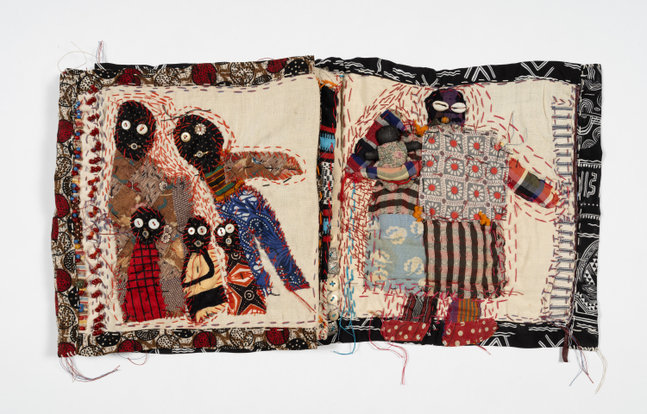
A book by Aminah Brenda Lynn Robinson can take up rather more space than its cover suggests. Her undated Button Beaded Book, documented in Colossal’s coverage of the artist, stretches to five feet when unfolded. Buttons, cowrie shells and scraps of patterned cloth populate its surfaces. The object makes a persuasive case for reading with more than our eyes: its construction is as much a part of the story as the figures it contains.
The book belongs to the world explored in Beaded and Bound, an exhibition at Fort Gansevoort in New York, running through January 16, 2027. Twenty-five works bring together Robinson’s experiments with books, fabric and dolls. Rather than separating the storyteller from the sculptor, the exhibition makes their relationship central.
Robinson was born in Columbus, Ohio, in 1940. Her family lived in Poindexter Village, a public housing development that became a recurring subject of her work. The title of her 1989 Women in Poindexter Village, Button Beaded Book announces a subject seldom granted the monumental treatment of historical painting: the women of an ordinary neighborhood. As Selvedge documents, the artist’s books could grow over years, accumulating new elements instead of remaining fixed at the moment of their completion.
The technique had roots in her childhood. Her father taught her to make books and a homemade modeling compound she called hogmawg; her mother passed on sewing and decorative needlework. Her biographical archive records her early artistic education and the importance of stories handed down by relatives. What might be dismissed as household craft became a means of giving those accounts physical presence.
The distinction matters. A conventional printed history can describe the life of a neighborhood, but Robinson’s choice of materials suggests another kind of record, one in which the labor of assembling and repairing things is itself worth remembering. The seams need not disappear. The individual pieces can retain their identities while contributing to a larger picture.
That approach extended to her depictions of local gathering places. Colossal identifies her 1983 work A Holy Place: The Elijah Pierce Barbershop as a tribute to the Columbus woodcarver and her friend. Its title gives a familiar social institution the gravity ordinarily reserved for religious architecture.
Robinson received a MacArthur Fellowship in 2004 and died in 2015. Her work continues through the Columbus Museum of Art’s legacy project, which includes preserving her work and making her former home available for creative residencies. That seems particularly appropriate for an artist whose books resisted the idea of a final page. The history she recorded belongs not only to the people who appear in her work, but also to those who will carry their stories forward.


Leave a Reply