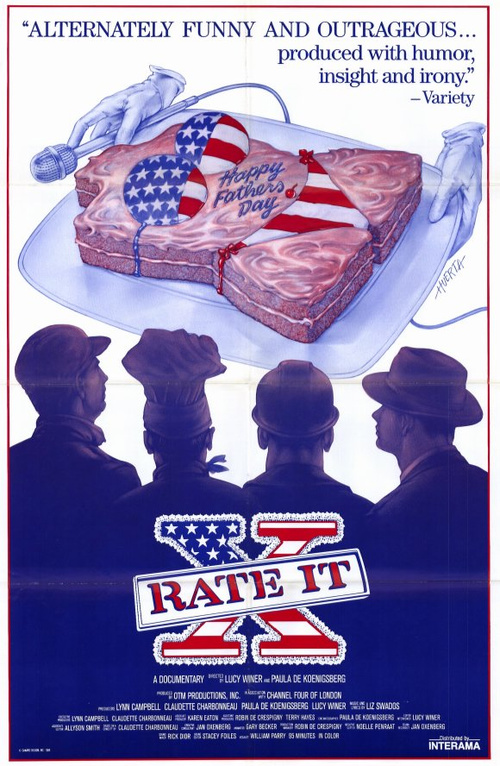
A cable-TV provocateur approaches women on the street and tries to persuade them to pose nude. Advertising executives explain their trade. A cartoonist responsible for a notorious feature in Hustler speaks for himself. The startling thing about Rate It X, a 1985 documentary returning to New York cinemas on November 20, is how readily its subjects make the filmmakers’ argument for them.
Lucy Winer and Paula de Koenigsberg traveled across the United States to interview men who made money from, or helped circulate, sexualized stereotypes of women. Rather than build a tidy lecture about sexism in mass media, they put a camera in front of the people creating the images and allowed their assumptions to become visible. The result was confrontational, but also often darkly funny.
Now Kino Lorber is presenting a new 4K restoration produced by IndieCollect. Its theatrical listing places the film at New York’s IFC Center from November 20 through 26 and Houston’s River Oaks Theater on November 20 and 21. The restoration offers a timely opportunity to revisit an independently made documentary that treated the entertainment and advertising industries as subjects worthy of direct interrogation.
Its title sounds like an exploitation-film come-on, and that is part of the provocation. In the mid-1980s, the X rating could sell a movie as transgressive while also warning viewers away. Winer and de Koenigsberg turn that language back toward the businesses that decided what women were supposed to look like and how their bodies could be sold.
The filmmakers’ method also poses a question for viewers now. When an interview subject says something appalling without apparent embarrassment, should a documentary interrupt with a rebuttal, or trust the audience to recognize what is happening? Rate It X works from the second impulse. The distance between the interviewees’ self-confidence and the picture they present of their industries becomes part of the film’s force.
That approach has its own limits. Giving powerful men room to talk can risk repeating the images and ideas a film intends to criticize. But it can also preserve evidence of attitudes that a more polished retrospective might smooth away. The documentary is therefore more than a period artifact of outrageous media behavior: it is a record of how commercial culture explained itself when someone bothered to ask.
For a generation accustomed to debates about algorithms, influencers and online pornography, the older technology may look quaint. The underlying question—who gets to profit by defining somebody else’s image—has not disappeared. A restored print makes that argument newly available in a cinema, where the audience can react together rather than scroll past it alone.


Leave a Reply