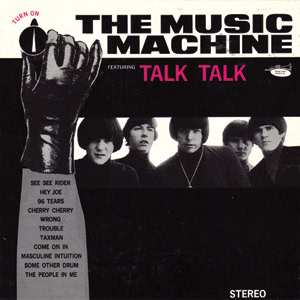
A single black glove can do a surprising amount of work. In photographs of the Music Machine, the five musicians look less like another group of hopefuls from the Los Angeles club circuit than members of a private society. Black clothes, dark hair and a glove apiece established an identity that was impossible to confuse with the reassuring smiles of television pop. In 1966, their hit “Talk Talk” supplied the musical equivalent: less than two minutes of tightly wound frustration.
Sean Bonniwell, the group’s singer and principal songwriter, understood that the appearance of a band could be inseparable from its sound. The Music Machine’s fuzz guitar, organ and abrupt rhythmic changes gave his songs a physical urgency. “Talk Talk” is not merely a loud record; its economy is part of its power. Bonniwell sounds impatient with the very conversation he is obliged to have. A decade before punk became a recognized movement, the record made alienation into something you could dance to.
Yet treating the Music Machine solely as a precursor to punk risks overlooking what Bonniwell was trying to accomplish on his own terms. The group could move beyond the blunt attack of its best-known single. Its debut album, (Turn On) The Music Machine, placed original compositions alongside interpretations of contemporary songs. The material planned for its successor offers an opportunity to consider the band beyond the constraints of a hit single.
That opportunity arrives on November 27, when Craft Recordings issues The Sound of Gloves for Record Store Day Black Friday. The collection begins with twelve recordings arranged in the sequence of the group’s proposed 1967 follow-up. Rather than presenting the demos as incidental extras, the compilers give the abandoned project a shape of its own. The titles alone suggest Bonniwell’s fascination with unease, confrontation and contradiction, from “The Trap” to “Affirmative No.”
The remainder of the collection puts that projected album alongside the group’s contemporary singles and studio alternatives. Four previously unavailable recordings include different versions of “See See Rider” and “Hey Joe.” Historian Alec Palao contributes liner notes. The Record Store Day listing confirms that the double LP is the collection’s first vinyl edition; a CD version will also be available.
There is something fitting about encountering the Music Machine through the record-shop culture that has kept so much garage rock alive. The band’s place in the canon was helped considerably by the inclusion of “Talk Talk” on the original Nuggets compilation in 1972. But compilations also have a way of reducing complicated artists to a single representative moment. The Sound of Gloves invites listeners to consider what happens when the needle keeps moving past the hit, and a remarkable band’s interrupted ambition becomes the center of the story.

Leave a Reply