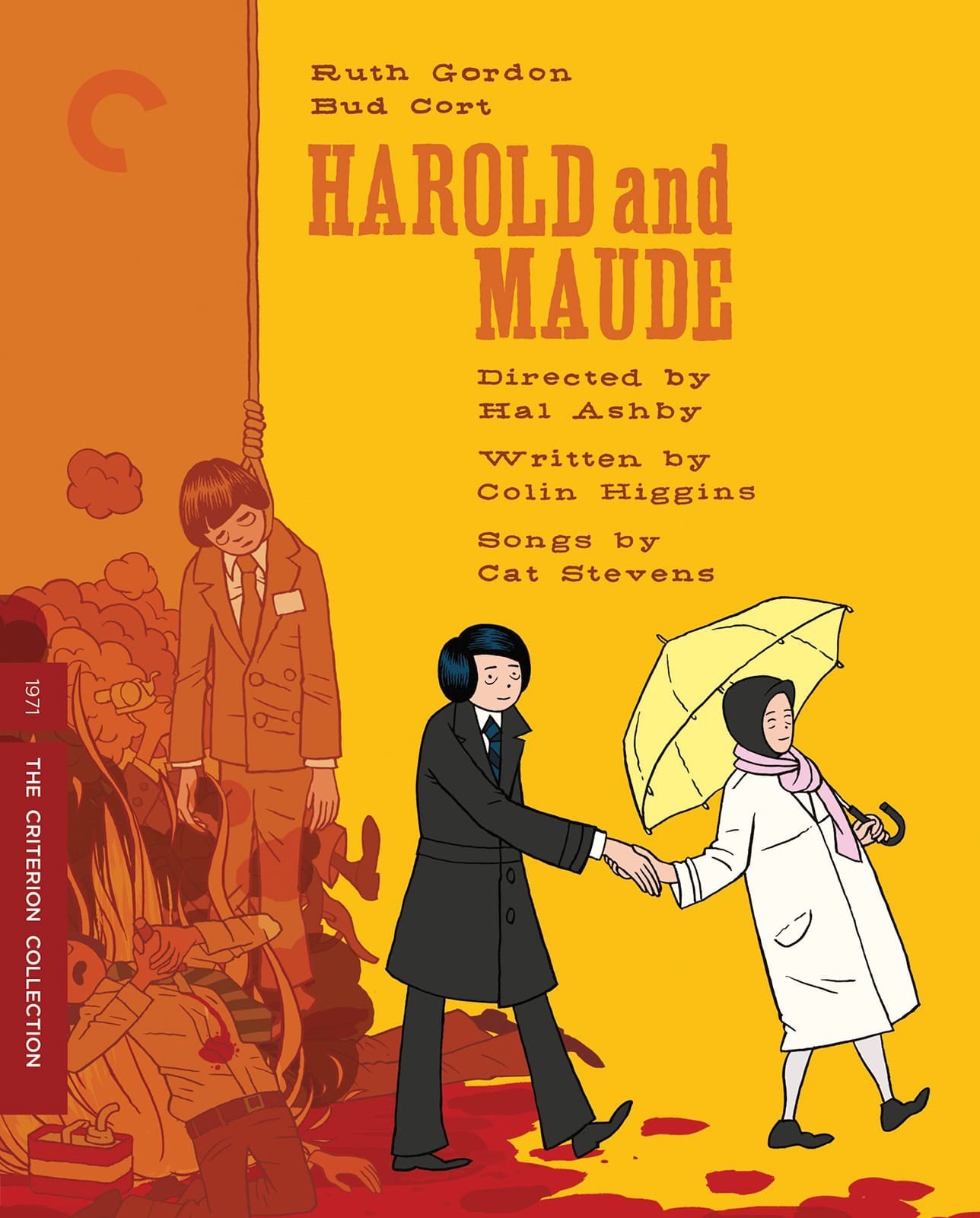
On November 3, Hal Ashby’s Harold and Maude returns to the Criterion Collection in a new 4K UHD edition. Fifty-five years after its 1971 release, the film’s most radical idea is still hiding in plain sight: an older woman is allowed to be the person who knows how to live.
Bud Cort plays Harold, a wealthy young man whose elaborate staged suicides are both a private obsession and a protest against his mother’s suffocating expectations. Ruth Gordon’s Maude, nearly eighty, treats convention as an optional arrangement. Their unlikely romance turns a morbid comedy into something unusually tender, without asking audiences to find their age difference comfortable.
The new edition offers a 4K digital restoration, Dolby Vision HDR on UHD, and both the original monaural soundtrack and an alternate 5.1 mix. Criterion also includes commentary by Ashby biographer Nick Dawson and producer Charles B. Mulvehill, an interview with Yusuf/Cat Stevens, and archival material involving Ashby, screenwriter Colin Higgins and the film’s performers.
Those extras matter because Harold and Maude is easily reduced to a cult-movie punchline: young man falls for eccentric old woman. Its real target is a social order that sorts people into approved behaviors by age and class. Harold’s family has money, influence and a carefully designed future for him; Maude, who has far less interest in property or status, possesses the freedom he cannot buy.
Gordon’s performance refuses the usual cinematic treatment of old age as either a punchline or a tragedy. Maude is mischievous, politically alert and physically present. She makes decisions, initiates experiences and insists that pleasure belongs to her. That perspective feels especially pointed in an industry where older women are still too often written as somebody’s mother, obstacle or memory.
The film is not free of complications. Its romantic premise can be read as liberating, unsettling or both, and its whimsical treatment of mortality has always invited debate. Yet Ashby’s achievement lies partly in leaving those contradictions intact. The comedy never fully cancels the melancholy, and the melancholy never wins the argument.
Cat Stevens’s songs help hold that balance together. Their warmth gives the film a pulse distinct from Harold’s carefully rehearsed gloom, making its movement toward connection feel earned rather than prescribed.
The Criterion release is therefore more than a technical upgrade. At a moment when catalog films are often sold through nostalgia, Harold and Maude offers a sharper reason to revisit the past: it asks whether the rules governing a respectable life were ever worth obeying.
Image: Criterion Collection edition artwork by Jordan Crane, reproduced for identification and editorial discussion. Source: The Criterion Collection. Release information: Criterion’s November 2026 schedule.



Leave a Reply