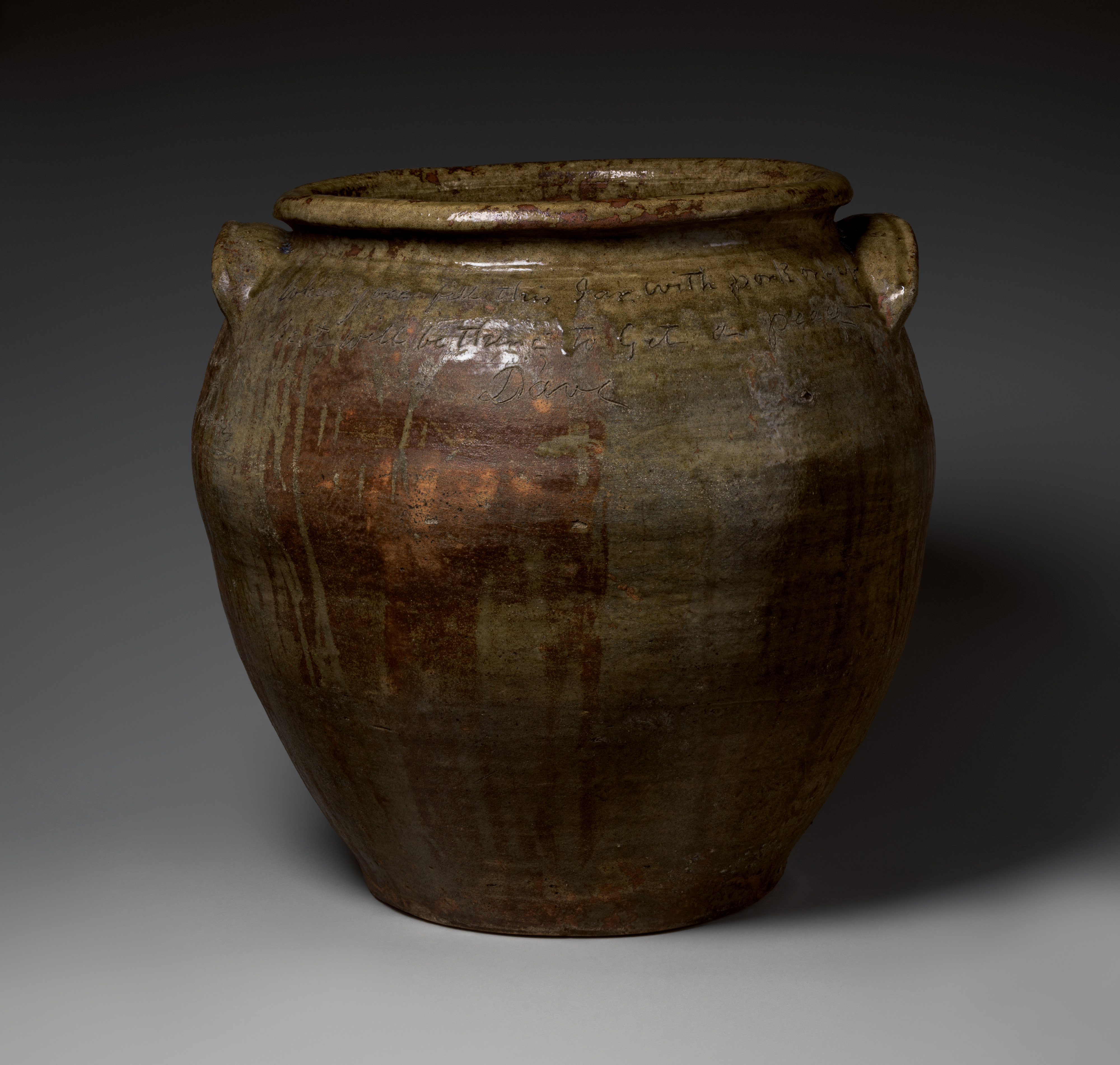
A jar can be a work of art, a historical document and evidence of a life denied its freedom. The Milwaukee Art Museum is now confronting all three meanings through an unusual agreement with the descendants of David Drake, the nineteenth-century South Carolina potter whose massive stoneware vessels sometimes carried his own poems.
Under an agreement announced by the museum this fall, ownership of two Drake vessels has been transferred to his family through the Dave the Potter Legacy Trust. One, a signed jar dated 1855, has subsequently been purchased back from the Trust by the museum with donor funding. The other, a jar attributed to Drake and dated roughly 1840–1850, remains the family’s property and is on long-term loan to Milwaukee.
The distinction matters. Both pots remain accessible to the public, but their continued presence is no longer simply a matter of a museum holding objects in its collection. Drake’s descendants have been recognized as people with a legitimate stake in deciding what happens to work their ancestor was never allowed to own. The two jars went on view September 30, following their donation to the museum earlier in 2026 by the Chipstone Foundation.
Born into slavery around 1801 in South Carolina’s Edgefield District, Drake spent decades making utilitarian stoneware on an extraordinary scale. Some vessels were large enough to hold many gallons of preserved food. Yet his work also crossed a boundary between craft and literature: he signed jars and pressed verses into wet clay, leaving a record of his voice in a society that restricted literacy among enslaved people.
His signature was no small gesture. The National Gallery of Art’s account of another Drake jar, made in 1859, explains how an inscription could declare authorship under circumstances designed to erase it. The Metropolitan Museum of Art likewise describes a monumental 1858 storage jar bearing Drake’s name and words. These are different objects from the Milwaukee pair, but they make clear why his surviving pottery is more than beautiful functional design.
The new arrangement also raises a difficult question for American museums: what does restitution mean when an artist’s work was made under enslavement, rather than taken from its original owner in a more conventional transaction? Milwaukee’s solution is neither a simple handover nor an insistence that the institution retain everything. It combines a purchase negotiated with descendants and a loan made possible by their continued ownership.
The museum says it intends to work with the family and community partners on future interpretation. Its existing Dave Project, developed with the Chipstone Foundation, has connected Drake’s pottery and poetry with students and local audiences. Those conversations now have a different starting point: the artist’s family is part of the story not only as history, but as a present-day participant.
For visitors, the jars may look much as they did before. The important change is invisible in the gallery label’s material description. It concerns who can claim a voice in the future of objects created by someone whose own voice was so determinedly preserved in clay.
Image: David Drake, Storage jar, 1858, alkaline-glazed stoneware, The Metropolitan Museum of Art (2020.7). Photograph: Zeray Peter / The Met Open Access, CC0 1.0. This image shows a separate vessel in New York, not either of the two Milwaukee jars.




Leave a Reply