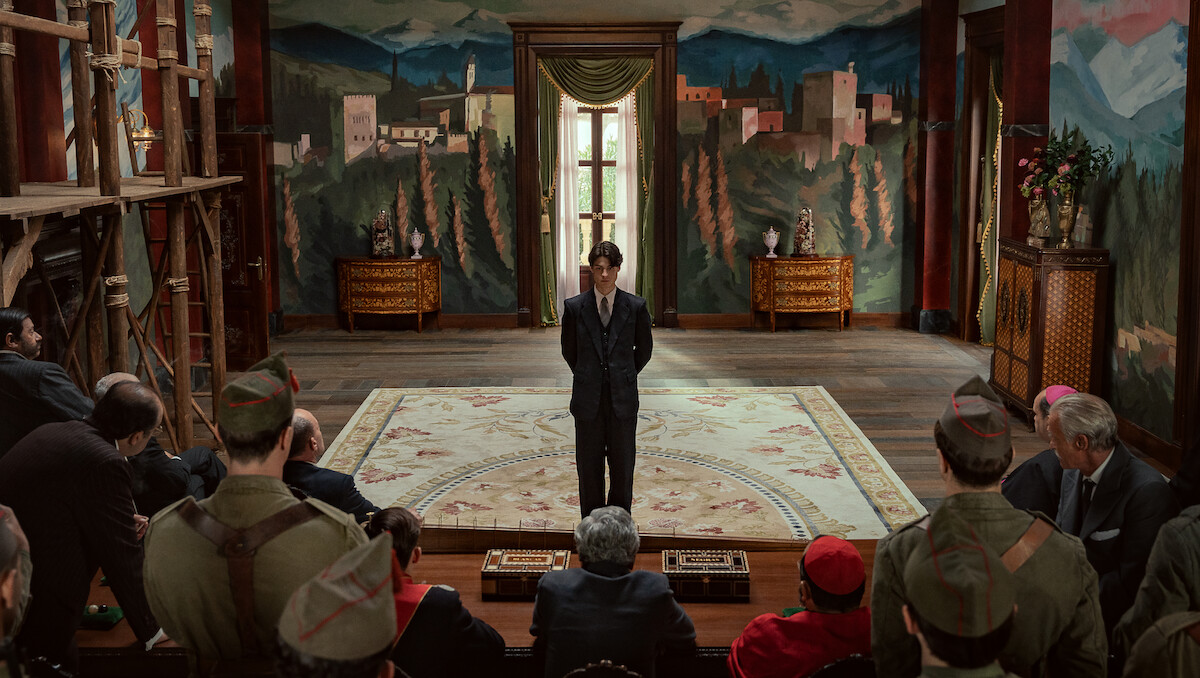
A film built around four surviving pages of an unfinished play is getting an unusually expansive life on screen. La Bola Negra, the Spanish drama by Javier Calvo and Javier Ambrossi, expands to more North American cinemas on October 30, including selected 35mm engagements, ahead of its Netflix arrival on December 2. The theatrical rollout matters: this is a story about the things history failed to preserve, being given space to exist beyond a streaming thumbnail.
The starting point is Federico García Lorca’s fragment La bola negra, written shortly before his murder in 1936. Its premise is stark. A young man seeks admission to a Granada social club, only to be rejected through a ballot of black and white balls because of his sexuality. Lorca left just four pages. Rather than attempt to pass off a completed Lorca work, Calvo and Ambrossi use that absence as the beginning of a new film.
The resulting drama moves between 1932, the Spanish Civil War in 1937, and Madrid in 2017. Milo Quifes plays Carlos, whose exclusion gives the original fragment its force. Singer-songwriter Guitarricadelafuente makes his acting debut as Sebastián, a musician whose relationship with a Republican prisoner, Rafael (Miguel Bernardeau), unfolds amid wartime violence. Carlos González plays Alberto in the contemporary strand, with Penélope Cruz and Glenn Close among the wider cast.
The directors, known together as Los Javis, previously made the television series Veneno and La Mesías. Their new film earned them a shared Best Director prize at Cannes in May. Yet the most compelling aspect of the project may be its refusal to treat the past as a neatly solved mystery. The connections across its three periods concern inheritance, secrecy and the cost of being unable to speak openly.
That approach makes the film more than a historical drama with a literary pedigree. Lorca’s unfinished manuscript is not simply material waiting for an adaptation; its incompleteness is part of the story. A murdered writer cannot tell us how he intended to finish it. Later generations can imagine possibilities, but they cannot recover certainty. The filmmakers’ response is to place invention alongside the historical record rather than pretend the distinction has disappeared.
There is also a productive tension in the distribution. Netflix has mapped out a staggered cinema release, including 35mm screenings in selected cities, before the film reaches home viewers. For a work concerned with lost voices and the physical traces they leave, that deliberate theatrical window feels particularly apt. The film asks audiences to look at what survives, what has been suppressed, and what art can responsibly reconstruct.
According to Netflix’s theater schedule, the October 30 expansion includes screenings in Chicago, Boston, Miami and Los Angeles, among other markets. The Cannes festival’s account provides further context on the filmmakers’ treatment of silence and memory. La Bola Negra arrives on Netflix December 2.
Image: Milo Quifes as Carlos in La Bola Negra. Photograph by Carla Oset / Netflix © 2026. Used for limited editorial commentary on the film.


Leave a Reply