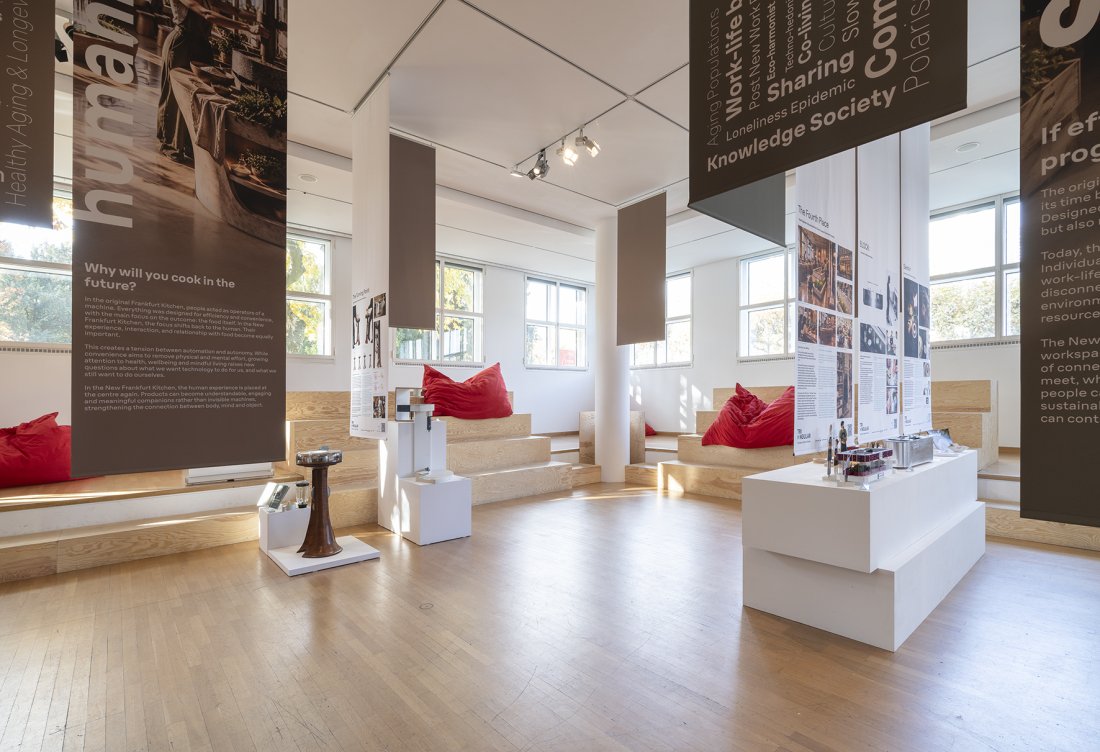
A kitchen barely seven square metres across helped change the modern home. One hundred years later, design students in Frankfurt are asking a more awkward question: what if the next kitchen should not be a room at all?
That is the premise of Triangular: New Frankfurt Kitchen 2040, at Museum Angewandte Kunst through November 29. The exhibition brings together 21 models and prototypes and another 30 concepts presented in student-made short films. Its starting point is Margarete Schütte-Lihotzky’s 1926 Frankfurt Kitchen, a radical attempt to make domestic work less exhausting through clever planning.
The original design was not a luxury showroom. Built for Frankfurt’s ambitious public-housing programme, it used fitted cupboards, carefully positioned work surfaces and short routes between storage, washing and cooking. More than 10,000 were installed. The museum preserves an original example, complete with the compact arrangement that made the design influential. It was an answer to a practical question: how much unnecessary movement could a person be spared while preparing dinner?
But efficiency has a complicated history. Making the kitchen easier to work in did not necessarily challenge the assumption about who would be doing that work. A century later, households are smaller or more fluid, cooking is sometimes communal, and questions of energy, accessibility and waste belong in the design brief. A kitchen planned only around one worker moving quickly between cabinets can seem as dated as a kitchen planned around a coal stove.
Students from Politecnico di Milano, TU Delft and İstanbul Teknik Üniversitesi have developed the new proposals with De’Longhi Braun Household and the rams foundation. According to the participating Milan design school, the work is organised around economy, society, humanity and culture. The museum says the designs move beyond the conventional room and consider objects and systems connected to producing, preparing and sharing food.
That makes this more interesting than another parade of shiny appliances. The useful question is not whether a countertop will look futuristic in 2040. It is whether domestic design can respond to people who share space differently, have different physical needs, or cannot afford to replace a whole kitchen when one component fails.
The historical kitchen is a reminder that ordinary objects can carry social ambitions. Schütte-Lihotzky’s fitted units were part of a larger effort to make decent housing available, not merely to sell a new look. The best measure of these student experiments will be similarly ordinary: whether they give people more time, more room and more freedom in daily life. A century after Frankfurt tried to redesign the work of cooking, the most radical possibility may be to redesign who gets to share it.



Leave a Reply