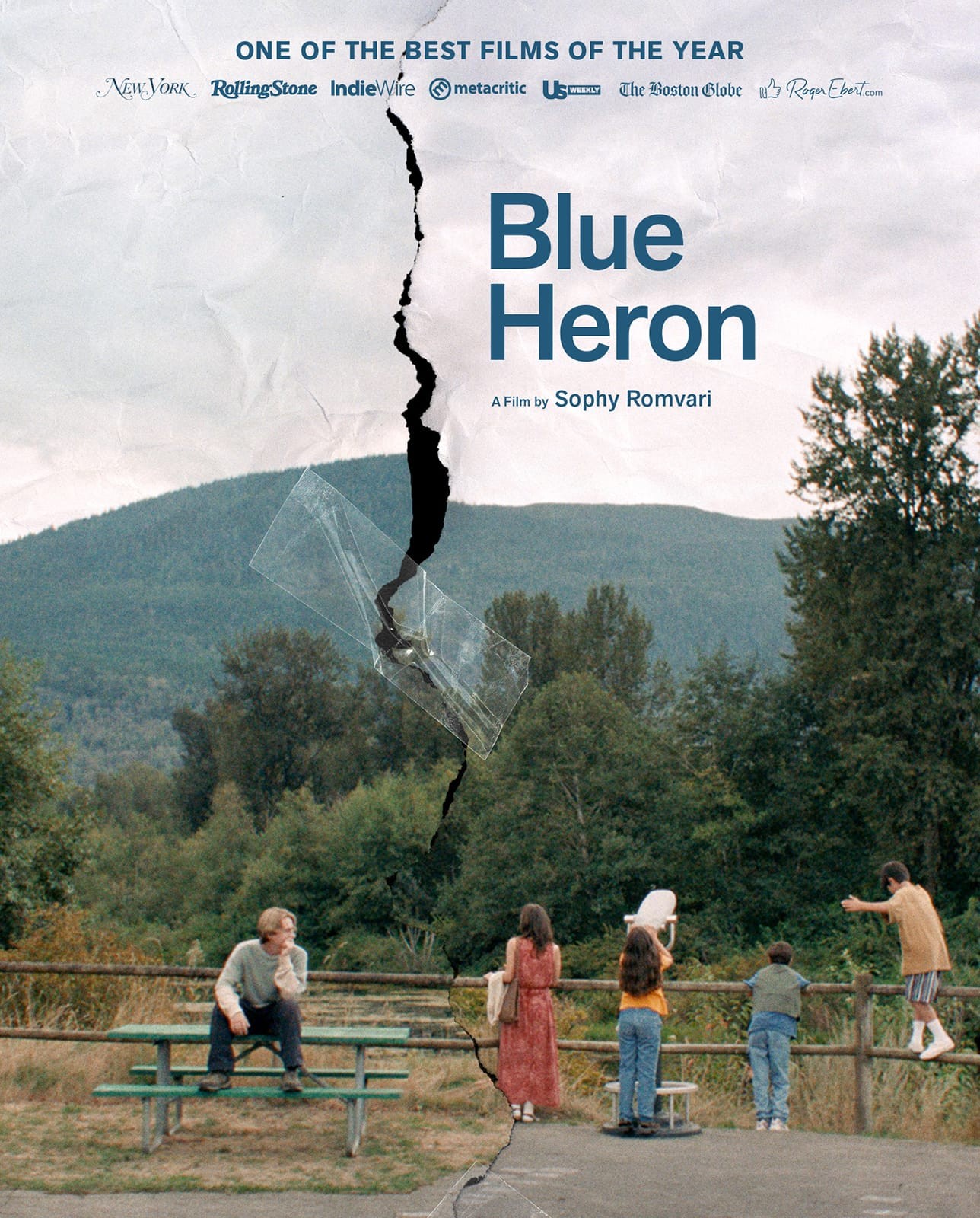
On November 10, Sophy Romvari’s Blue Heron arrives on Criterion Blu-ray and DVD, a notably swift home-video milestone for a debut feature that reached American theaters earlier this year. The release is more than another endorsement for a promising director. It places a film about the unreliability of childhood memory alongside a short that shows how Romvari developed her way of looking at family history.
Set on Vancouver Island in the late 1990s, Blue Heron follows eight-year-old Sasha, played by Eylul Guven, after her Hungarian Canadian family moves into a new home. The apparent calm of a summer landscape is unsettled by the increasingly dangerous behavior of her older brother Jeremy, played by Edik Beddoes. As their parents confront choices that no family wants to make, the story becomes as much about what a child can understand as about what adults try to conceal.
That distinction is central to the film’s achievement. Stories of troubled families often organize their material around the moment everything falls apart. Romvari is interested in a different question: what survives in a child’s recollection before the events have acquired an adult explanation? A gesture, a room or the atmosphere of an ordinary afternoon can carry more weight than an explicit account of what went wrong.
The film moves between past and present rather than treating childhood as a sealed-off period. Its perspective suggests that memory is not simply a record waiting to be retrieved. It is something continually revised by later knowledge, grief and the stories family members tell—or decline to tell—one another. That makes its gentle surfaces deceptive: the apparent modesty of the images is part of their emotional force.
Criterion’s edition pairs the 91-minute feature with Romvari’s 2020 short Still Processing, as well as a new Criterion Channel interview and notes by critic Beatrice Loayza. The pairing matters. In Still Processing, Romvari also draws on family photographs and the difficulty of approaching painful personal history. Seen together, the two films offer a compact account of an artist developing a language for experiences that resist straightforward dramatization.
Criterion’s official edition listing confirms the November 10 release date and supplements; its August Channel programme also documents the film’s earlier streaming presentation. The disc is not a restoration of an established classic but an attempt to preserve a new film’s context while that context is still fresh.
For a story concerned with what families keep, lose and reinterpret, that is a fitting form of permanence. The additional short does not solve the feature’s mysteries. It helps explain why Romvari believes some memories deserve to remain complicated.


Leave a Reply