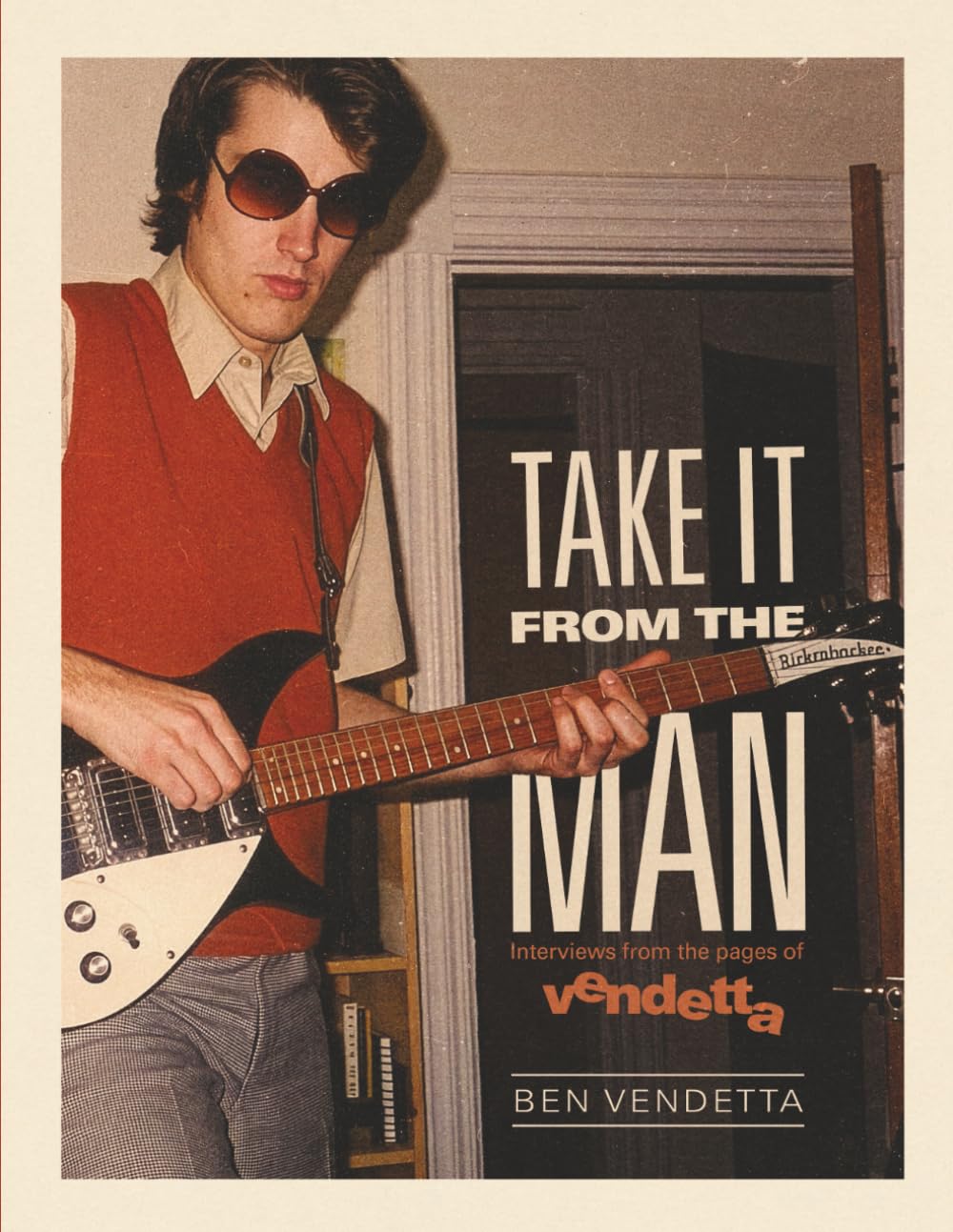
From Spacemen 3 and The Brian Jonestown Massacre to Swervedriver, Mojave 3 and overlooked underground favorites, a new anthology preserves independent music in its own words.
There was a time when discovering a great band required a little detective work. You followed obscure record labels. You memorized the names on record sleeves. You took a chance on something because a friend wouldn’t stop talking about it, or a tiny music magazine made it sound like the most important thing in the world.
And if you were lucky, the record delivered. Suddenly you belonged to a community you might never have met in person.
Ben Vendetta didn’t just inhabit that world. As the editor of Vendetta magazine, he helped document it. His new book, Take It from the Man: Interviews from the pages of Vendetta, gathers the voices of bands that shaped the psychedelic, shoegaze and independent-rock underground around the turn of the millennium. In an era when practically every recording is only a search away, the book asks a more interesting question: what did these scenes feel like while they were happening?

Before the Mythology
The lineup reads like the contents of a particularly adventurous record collection: Spacemen 3, The Brian Jonestown Massacre, The Dandy Warhols, Swervedriver, Catherine Wheel, Whipping Boy and Mojave 3. They’re joined by Lilys, Comet Gain, For Against, The Curtain Society, The Tyde, Outrageous Cherry and Honeyrider.
It’s precisely that mix that makes the anthology worth paying attention to. Music history has a habit of looking backward through the winners, granting the biggest reputations the biggest chapters. But independent scenes don’t develop according to eventual sales figures. A band with a devoted following of a few hundred people can shape an entire circle of musicians, writers and listeners.
By putting cult names alongside the more familiar ones, Vendetta’s collection captures something closer to the way independent music actually worked: as a network of discoveries, influences and overlapping obsessions.
The Value of Being There
What distinguishes an interview preserved from the 1990s or early 2000s from one conducted today? Timing. The musicians weren’t delivering carefully rehearsed accounts of what their careers would eventually mean. They were discussing their work at a point when its legacy was still unwritten.
Retrospective music history can be illuminating, but it has its blind spots. Once a record becomes a classic, it’s tempting to imagine that everybody knew its importance from the beginning. Contemporary interviews preserve the uncertainty, ambition and priorities of the moment before hindsight smooths them into a story.
That’s what makes the format of Take It from the Man so promising. These are not memories reconstructed decades later, but conversations conducted when the music was still new.
When Fanzines Were Part of the Scene
Vendetta published his namesake magazine from 1995 to 2002, during an especially fertile period for independent guitar music. The internet existed, of course, but it had yet to reorganize discovery, publicity and cultural conversation into the constant stream we know today.
A fanzine could be deeply subjective, gloriously obsessive and full of conviction. Its authority came less from institutional prestige than from the editor’s curiosity and willingness to seek out bands that weren’t being handed national coverage.
Publications like Vendetta didn’t simply document an underground scene. They helped connect its participants. An interview might introduce a reader in one city to a band thousands of miles away. A concert photograph or a carefully designed page could become part of the mythology of a group still playing small rooms.
That do-it-yourself infrastructure deserves a place in music history alongside the labels, venues and records. It was how culture moved before every new release arrived with its own publicity machine.
A Visual Record of a Vanishing Culture
Take It from the Man is more than a collection of words. The large-format paperback contains nearly 100 images, including photographs and gig artwork. That’s a meaningful part of the appeal.
A surviving flyer can capture a night that otherwise lives only in the memories of the people who attended. A photograph can reveal something about how a band presented itself before stylized online identities became unavoidable. The physical traces of a scene can tell stories that streaming services cannot.
Bringing interviews and visual ephemera together turns this anthology into a record of the culture surrounding the music, not just the musicians making it.
More Than Nostalgia
There is an obvious nostalgic pull to a book devoted to an era of mail-order records, fanzines and small clubs. But the stronger case for preserving this material isn’t that things were necessarily better then. It’s that they were different, and that those differences shaped what people made and how they heard it.
Today’s listeners can explore the work of nearly all these artists without tracking down a single import CD. What they can’t download quite so easily is the context: the thrill of discovery, the friendships between distant scenes, the small publications willing to champion a record before anybody else cared.
That is the larger value of Vendetta’s project. Its interview roster spans famous cult bands and names that deserve renewed curiosity, reminding us that independent music was never a neat hierarchy with a handful of stars at the top. It was a sprawling conversation.
Before independent rock became an endlessly searchable archive, somebody had to care enough to ask the questions, print the answers and send the magazine out into the world. Take It from the Man brings those conversations back into circulation.
Book: Take It from the Man: Interviews from the pages of Vendetta by Ben Vendetta. Independently published, September 2026. Large-format paperback, 162 pages. ISBN 9798185141007.
Where to Buy: Amazon | Books-A-Million

Leave a Reply